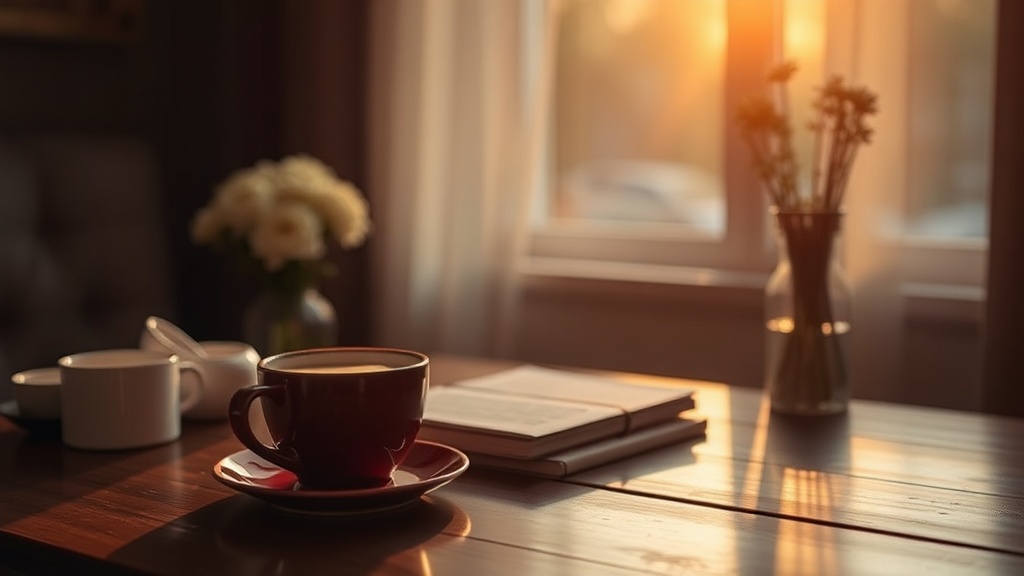
Savoring Slow Mornings with Analog Rituals

The weight of a ceramic mug, the rhythmic scratch of a fountain pen on heavy paper, and the slow drip of a Chemex brewer define a morning spent outside the digital loop. This post explores the practical application of analog rituals to reclaim your focus and mental clarity during the first hours of the day. We'll look at why slowing down matters in a high-speed world and how you can integrate tactile, non-digital habits into your daily routine without feeling overwhelmed.
Most of us reach for our smartphones before our eyes are even fully open. We trade the quiet of the dawn for a flood of notifications, emails, and news cycles. It's a heavy way to start a day. By the time you've even brushed your teeth, your brain is already reacting to the world instead of setting its own pace. I've found that reintroducing analog elements—things that don't require a battery or a Wi-Fi connection—changes the entire trajectory of my productivity and mood.
It isn't about being a Luddite or hating technology. It's about intentionality. It's about choosing when to engage with the digital world and when to remain present in the physical one.
Why Should You Prioritize Analog Rituals?
Prioritizing analog rituals helps reduce cognitive load and lowers early-morning cortisol levels. When you start your day by interacting with physical objects—like a book, a plant, or a manual coffee grinder—you are engaging your senses in a way that a screen simply cannot replicate. This groundedness provides a sense of stability before the chaos of the day begins.
The constant dopamine hits from scrolling are actually quite draining. Research into human attention suggests that our ability to focus is constantly being fragmented by digital interruptions. A study by the National Institutes of Health often highlights how excessive screen time affects cognitive function and sleep patterns. By choosing an analog morning, you're essentially giving your prefrontal cortex a chance to wake up gently.
Think about the difference between reading a news feed and reading a physical book. One is a frantic, infinite scroll; the other has a beginning, a middle, and an end. That sense of completion is deeply satisfying for the human brain. It provides a sense of accomplishment that a "refresh" button never will.
The Best Tools for an Analog Morning
You don't need much to start. In fact, the more complex you make it, the less likely you'll stick to it. Here are a few items that have become staples in my own morning routine:
- A Manual Coffee Grinder: Using a Hario or a possible even a simple hand-crank grinder makes the process of making coffee a sensory experience rather than a chore.
- A High-Quality Notebook: Whether it's a classic Moleskine or a Leuchtturm1917, the act of writing by hand forces you to slow down your thoughts.
- A Mechanical Alarm Clock: This is a big one. If your phone is your alarm, you're already lost. A simple Seiko or even a vintage Westclox ensures your phone stays in another room.
- Physical Books: Not an e-reader, but a real, paper book. The smell of the paper and the tactile feel of turning pages matters.
I've noticed that when I use a fountain pen to jot down my thoughts, my thinking becomes more linear. There is no "backspace" on paper. You have to live with your mistakes, which, oddly enough, makes the process feel more authentic and less pressured.
How Can I Implement a Slow Morning Routine?
Implementing a slow morning routine involves replacing digital triggers with physical ones through small, incremental changes. You don't have to overhaul your entire life overnight; instead, pick one "digital-free" window of time—perhaps thirty minutes—and fill it with a physical task.
Start with the "Phone-Free First Hour." This is the gold standard for anyone struggling with morning brain fog. If you can't go an hour, try thirty minutes. During this time, your only goal is to interact with the physical world. This might look like:
- Making a manual pour-over coffee.
- Doing a five-minute stretching routine.
- Writing a single paragraph in a journal.
- Observing the light changes in your room.
It sounds simple, but it's actually quite difficult once you realize how much we rely on digital stimulation to "wake up." I used to think I needed the news to feel "ready" for the day. I was wrong. I was just making myself anxious before I'd even had breakfast.
If you find yourself reaching for your phone out of habit, try keeping a book or a magazine on your nightstand. It's a physical "nudge" to engage in a different way. This idea of "environmental design" is a concept often discussed in behavioral psychology—you are essentially setting your environment up for success.
Comparing Digital vs. Analog Morning Habits
| Feature | Digital Morning | Analog Morning |
|---|---|---|
| Primary Stimulus | Blue light / Notifications | Natural light / Physical textures |
| Mental State | Reactive (responding to others) | Proactive (setting your own pace) |
| Focus Level | Fragmented / Short attention span | Deep / Sustained attention |
| Physicality | Passive (scrolling/tapping) | Active (grinding/writing/moving) |
The table above shows the stark difference in how these two approaches affect your brain. A digital morning is often about reacting to the world's demands, while an analog morning is about preparing yourself to meet them. One is a defense; the other is an offense.
Is a Slow Morning Worth the Effort?
A slow morning is worth the effort because it builds a foundation of mental resilience that carries through your entire workday. When you have successfully navigated the first hour of your day without the frantic energy of the internet, you feel more in control of your time and your attention.
I've found that my productivity in the afternoon is directly tied to how I spent my morning. If I spent my morning in a state of digital hyper-stimulation, I'm usually burnt out by 2:00 PM. If I spent my morning with a quiet cup of coffee and a notebook, I find I have a much more stable energy level. It's not about doing more; it's about being more present in what you're already doing.
This ties back to the idea of a "curated life." Much like building a curated capsule wardrobe, your daily rituals should be a collection of things that actually serve you, rather than just things that are "available." You are the curator of your own time.
Don't feel like you need to buy a whole new set of expensive gear to make this work. A simple, cheap notebook and a standard French press are more than enough. The goal isn't to collect "stuff" that looks good on a shelf; the goal is to find a rhythm that feels right for you.
Sometimes, the most productive thing you can do is nothing at all. Or, at the very least, something that doesn't require a screen. Sit on your porch. Watch the birds. Listen to the kettle whistle. These aren't "wasted" moments—they are the moments that make life worth living.